Burning gasoline and diesel in the 21st century is hardly less absurd and anachronistic than burning a witch, and if, after driving bans due to the diesel scandal and emissions manipulation, only cars from Tesla and Toyota are driving through Stuttgart and Wolfsburg soon, the German automotive industry will suddenly go all in on electric vehicles.
However, like the railroad blogger Niki Schmölz correctly wrote, while the electrification of road transport represents a shift in propulsion systems, it is far from a transport revolution: “A livable city requires not only clean air, but also enough space for open areas and housing. The automobile has been occupying large areas for years, and a battery won’t change that.”
Especially in a big city, it feels annoying and unreasonable to waste the roads on daily commuter traffic jams instead of promoting public transport and cycling. As a positive example, the university city of Münster, already known for its bicycle-friendliness, plans to financially support the purchase of cargo bikes from 2019 onwards.
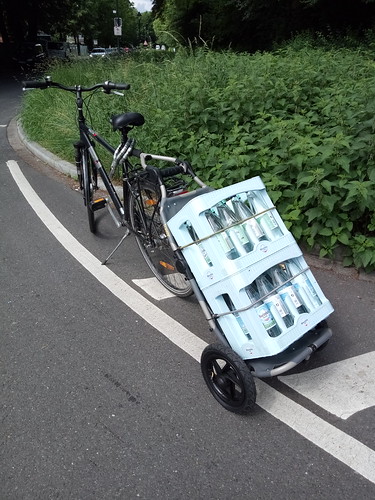
Alternatively you could also get a bicycle trailer, for example a Burley Travoy, which folds up very compactly and can transport two full crates of drinks. The trailer hitch can be retrofitted to an existing bicycle.
Realistically speaking, it remains difficult to completely do without a private car, especially if you or your relatives live in a rural area, but for urban life, public transport, bicycles and car sharing concepts now offer many opportunities to be part of the solution rather than part of the problem more often.
The German Duden dictionary defines mobility transition (Verkehrswende) as a “fundamental restructuring of public transport [especially with ecological objectives]”. Back in 1991 already, an association by that name (Verkehrswende e.V.) formed in Münster. This later led to the car sharing project “Stadtteilauto”.
The study by ecologist Frederic Vester, published under the title Ausfahrt Zukunft (“Exit: Future”), already called for a transport revolution in the 1980s, which unfortunately is still more wishful thinking than reality.