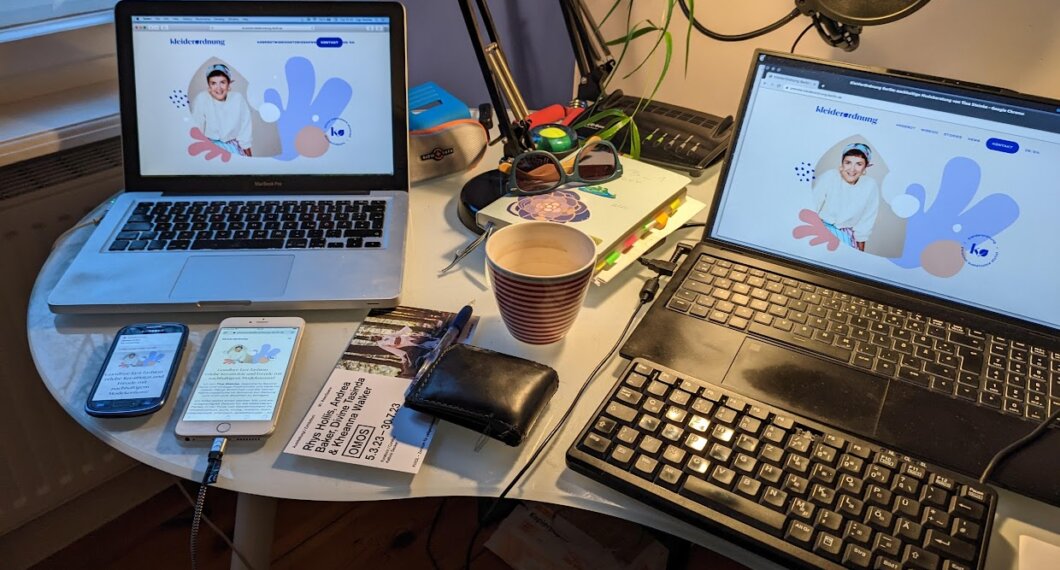


Specific customer project examples:
- sustainable fashion consultant Tina Steinke (Kleiderordnung Berlin)
- Kunnig Konsulting financial services, Liechtenstein
- gemeva, Zürich: project management for change and transformations projects
or more minimal classic websites:
- Dr. Samuel Felix Sieber, Supervisor & Coach in Berlin
- Raum für Eigensinn für Menschen mit und ohne Typ 1 Diabetes
Simple might not seem good enough to some, but designing simple websites is no longer so easy when the amount of content and the requirements grow.
Simple, Ageless and Classic or Extravagant Maximalism?
While government agencies and institutions can, or even must, consciously opt for clarity and simplicity, startups and innovation-driven corporate clients tend to aim to attract attention and create a playful experience through distinctive design and effects. It remains crucial that the accessibility and accessible nature of a website don’t get sacrificed in favor of perceived trends and complex web design concepts, but rather that design and usability come together as a synergy.
Simple Language or Technical Terms?
 Simple language sounds simple, but it’s easier said than it’s written. Plain or simple language should not be confused with “Easy Language”, which follows set rules. Technical terms are important to prevent misunderstanding, but we customers communication benefits when we prefer easier terms.
Nevertheless, I will venture to address some terms and, in some cases, explain them or refer to further sources. Besides legal and technical terms like accessibility, which are relatively clearly defined, there are buzzwords like DevUX or SustainableWeb that not even all web developers and web designers understand.
DevUX: Connecting Web Development and Design
By sustainably elegant web design, I mean, in a broader sense, both the design (concept, graphics, UX, UI) and the implementation (software architecture, technology selection, programming, and quality assurance). It would generally be helpful to break down the rigid separation between design and development and to collaborate from the outset (DevUX). Creating static preview pages with placeholder text and then handing them off to another team seems to me like a relic from the days of printing presses and errand boys, and an avoidable source of misunderstandings and dissatisfaction.
Changing Requirments by Customers and Legislation:
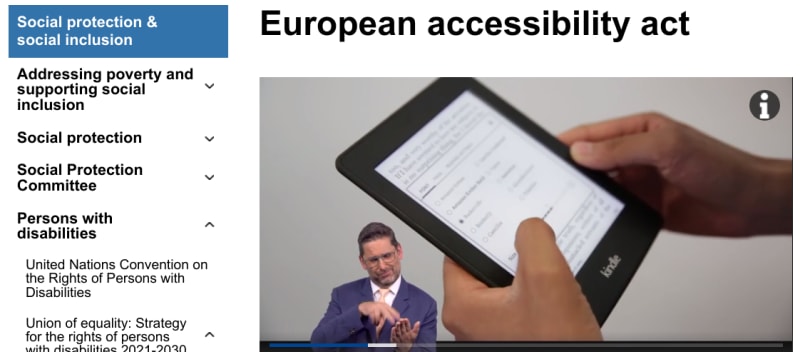
The upcoming legislation changes concerning sustainability topics seem ambitious. Specifically, following the Sustainable Supply Chain Act, which aims to give greater weight to the international Sustainable Development Goals (SDGs) across all sectors, the European Accessibility Act (EAA) will introduce a comprehensive accessibility requirement for European websites in 2025, similar to the existing requirements for commercial and public providers in the USA. Measurable criteria will be based on the WCAG guidelines.
Even exceptions (omnibus) and the absence of waves of cease-and-desist letters do not change the fact that social and environmental sustainability also brings clear economic advantages. While renewable energies make a society independent of fossil fuels in the long term, and public-benefit-oriented open-source software independent of purely profit-driven priorities, accessibility, multi language localization, and responsive device compatibility potentially attract new customers.
Ecological web optimization can be subsumed under the new buzzword SustyWeb. Regarding the legal changes that will affect us as creatives and web developers from 2024 onwards, I must point out, as always, that I am not a lawyer and this should therefore not be misunderstood as legal advice. Please consult a lawyer you trust to understand how the legal situation specifically applies to you and your clients!
About me: I am Ingo Steinke, an experienced freelance web developer in Berlin, professionally producing, extending and optimizing websites and web apps for more than two decades. I work for various customers ranging from small startups and fellow freelancers to complex project that you can find in my portfolio projects, references and case studies. In this post I focused on smaller projects, because they allowed me to work free from existing legacy code and company policy requirements, where sustainability and accessibility often did not have the priority they should have for economic reasons.
Progress instead of Disimprovement
I certainly hope that the new laws don’t lead to a similar case of “improvement” as the General Data Protection Regulation (GDPR), which transformed a well-intentioned data protection initiative into a bureaucratic absurdity that seemingly forces us to obscure the actual content of a website with a banner full of fine print upon first accessing it, in order to coerce visitors into agreeing to unread waivers. I have also described and demonstrated several times that there are other ways to do it.
My optimism is therefore not unfounded; moreover, a great deal has changed very positively in the web scene in recent years. Green web hosting with renewable energy, data minimization, and improved user experience are recognized by well-known auditing tools such as PageSpeed/Lighthouse and WebpageTest. Meanwhile, Ecograder, WebsiteCarbon, and the Green Software Foundation are setting new standards with even stricter and more specific measurements. Accessibility audits using axe and WAVE at least warn about blatant violations of WCAG requirements.
Technical progress of browsers and other web technologies make it easier to use semantic markup and flexible style sheets to design and animate exactly what specific devices support and individual users solicit.. Transparency, constrast, pastel colors, movement and speech are among aspects presenting the same content via different channels alternatively or simultaneously. Modern media and feature queries based on contrast and animation preferences (prefers-contrast, prefers-reduced-motion, prefers-reduced-transparency etc.) facilitate coding this effictively and clearly.
Container queries, grid layout and fluid typography enable modular web design working robustly and flexibly, not bound to page and pixel widths anymore. Color spaces beyond sRGB let colors shine more brightly on modern monitors. Blend modes, transparency, and perspective layers enable effects like those in animated films—interactive, energy-saving, and without dependence on commercial software such as the once-celebrated, later discredited, and finally forgotten Adobe Flash technology.
While many creatives and developers still ignore these kinds of new technological possibilities, others research and explore them even more intensely, sharing their experience in inspiring talks and workshops, for example at Beyond Tellerrand conferences.
Instead of a comprehensive collection of helpful links, I’ll start with my DEV publication on the same topic: Accessibility, SustyWeb, SDGs, and upcoming European Legislation in 2024/2025.
Last, but not least, here’s another bad example to contrast with the good ones mentioned earlier. You might have noticed that most of my reference projects unusually manage without cookie banners. Thanks to data minimization and privacy-compliant open-source statistics, this is still feasible in 2025. Overall, I remain hopeful and will continue to contribute good examples of sustainably elegant web design.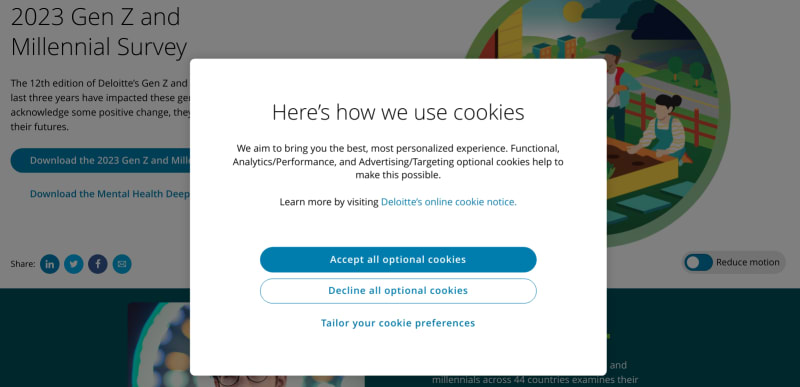
The image above should be understood as a counter-example to everything mentioned above. Rather, it illustrates the detrimental effect of cookie banners, which have become commonplace as a result of well-intentioned data protection laws.